The Other Side of the Canopy: Balancing Commercial Kitchen Extract with Make-Up Air
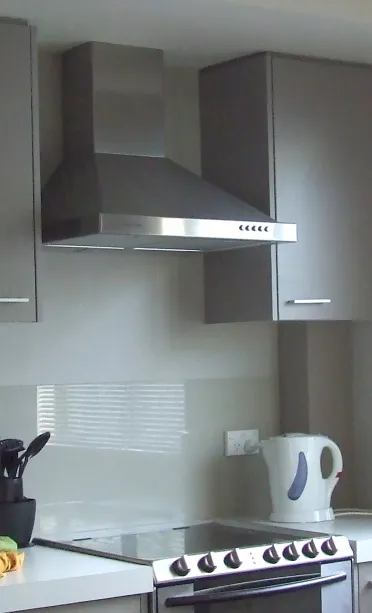
Photo: http://en.wikipedia.org/wiki/User:Iain, Copyrighted free use, via Wikimedia Commons
Commercial kitchen ventilation is often judged by the extract fan. If the canopy pulls strongly and the grease filters stay in place, the system is assumed to be working. But extraction is a transfer of air, not a solo performance. Every cubic metre expelled from a kitchen must be replaced. If replacement air is restricted, the extract fan simply works harder against a building that cannot supply it. The result is negative pressure, poor capture, odour migration and, in the worst cases, a gas safety problem.
Extraction needs a counterpart
Make-up air is the purposeful supply of replacement air to the kitchen. It may come from a dedicated supply air unit, a transfer path from adjacent spaces, or, in smaller premises, controlled infiltration. Natural leakage is not a design strategy. It is unpredictable and often pulls air through the wrong routes: dining areas, toilets, storerooms, drainage traps and flues. A properly designed system balances extract and supply so that the kitchen remains slightly negative to surrounding areas, containing cooking odours without starving the appliances or the canopy.
Symptoms of negative pressure
Negative pressure reveals itself in everyday operation. Doors become difficult to open or close, sometimes dragging or slamming. Staff may prop doors open, which destroys the intended pressure regime. Odours migrate into the dining room or neighbouring units. Grease-laden air may be drawn across the kitchen rather than into the hood. Extractor fans sound strained. In winter, cold draughts appear from unexpected openings. These are not minor annoyances; they are symptoms of an unbalanced system. A pressure differential that is too negative can also pull combustion products from open-flued appliances into the room.
Gas safety is non-negotiable
Commercial kitchens often contain gas-fired ranges, fryers, ovens and water heaters. Some appliances rely on room air for combustion and on a flue for products of combustion. If the kitchen is starved of make-up air, the appliance may spill flue gases into the room instead of venting safely. That is a carbon monoxide risk, not a comfort issue. Gas interlock systems, where fitted, should be checked as part of the ventilation regime. Any work on gas appliances or associated flues must be carried out by a Gas Safe registered engineer. Ventilation maintenance should never be treated as a separate trade from gas safety; the two interact.
Commissioning the balance
Commissioning should measure both sides of the system. Extract airflow, supply airflow, hood face velocity and room pressure differential should be recorded against the design figures. A smoke pencil or similar tracer can show whether air is being captured at the hood and whether supply air is short-circuiting straight back into the extract. Doors should be operated under normal conditions, and appliance flues should be checked for satisfactory draught. The specification for kitchen ventilation systems, BESA DW172, provides a useful technical reference, while Approved Document F addresses ventilation provision in the wider building. The commissioning record should include the settings of dampers, fan speeds and any tempered-air unit. Without that record, future maintenance has no baseline.
Maintenance that preserves the design
Grease filters need regular cleaning; blocked filters reduce capture and change the pressure balance. Extract fans, belts and bearings need inspection. Supply air units need filter changes and coil cleaning. Dampers should be checked for movement, not just presence. Sensors and interlocks should be tested. If a fan is replaced or a speed changed, the balance should be rechecked rather than assumed. Many failures are not catastrophic; they are gradual. A make-up air unit that has quietly tripped out, or a fire damper that has dropped, can turn a compliant design into an underperforming one.
Retrofit and operational discipline
Retrofits deserve particular care. A new high-capacity extract system installed without a matching supply path will worsen negative pressure. Conversely, adding supply air without considering extract will push cooking odours into the dining area. The right approach is to treat extract and make-up air as one system, with a clear design intent and a maintenance plan. Staff should know how to report door drag, odours or unusual draughts. Managers should keep commissioning records, filter logs and gas safety certificates together. The canopy may be the visible half of kitchen ventilation, but the missing half is the air that makes extraction possible.